Creating Meaningful Connections Through Understanding Our Nervous System

Last month in our blog, Julie Petrynko wrote about the Loneliness Epidemic in Canada and how loneliness impacts our mental, physical, and emotional health. She explored ways to mitigate loneliness through connection to self and others.
This month, I want to share how to create meaningful connections through a deep understanding of our shared human neurobiology using some of the curriculum we teach in our BetterLove Project Curriculum (https://www.betterloveproject.ca/). Let’s dive into your most important relationship: the one with your nervous system.
Why is Nervous System Regulation Important?
Nervous system regulation is the foundation of healthy connections, both to ourselves and to others. Connection is our primary basic human need. As Brené Brown likes to say, our nervous system is hardwired for connection. This is because we are pretty defenseless when we are alone in the wilderness. We have no fangs, no claws, and no fur. We are designed to work together to keep each other safe. Our nervous systems feel best when we are in loving, supportive relationships where we can truly be ourselves.
Connection happens pretty naturally when we feel safe, regulated, positive, and low-stress. Our bodies produce hormones like oxytocin, serotonin, norepinephrine, and dopamine. These hormones connect us to other people because they help us feel positive, joyful, open-hearted, and even loving.

When we are dysregulated, stressed, or activated, we produce the hormone cortisol. Even though we need support the most when we are dysregulated, cortisol works to distance us from others. It makes us seem edgy, judgmental, angry, and even dangerous to those around us.
Understanding Dysregulation
Dysregulation, or "crashing out," as my 12-year-old son calls it, is a totally normal human response to stressful situations. It is even healthy, as long as it comes and goes in a reasonable amount of time, and we know how to manage it.
We know there is a healthy window of tolerance where we feel most like ourselves. Dysregulation can either be above or below this window. Above the window is called hyperarousal. In hyperarousal, we might feel anxious, overwhelmed, energized, manic, or even the need to fight or flee. Below the window is called hypoarousal, and in this state, we might feel depressed, dissociated, helpless, frozen, or stuck.

What the Heck is a Vagus Nerve and What Does it Do?
The vagus nerve is the main player in the parasympathetic nervous system, which is responsible for calming us down after stress. It acts as a two-way communicator between the brain and our organs, sending messages back and forth. The vagus nerve runs from the base of your skull to the base of your gut along the spinal column.

Dysregulation occurs when the parasympathetic nervous system, or our "rest and digest" system, weakens and leaves the body stuck in a stress response. So, as we talk about being in a relationship with our nervous system, it really is about how we can strengthen our vagus nerve.
Can Strengthening My Vagus Nerve Prevent Dysregulation?
You can definitely build skills to help prevent dysregulation. Knowing our window of tolerance and where we are within it is the first step in strengthening our vagus nerve. If we can create a reflective practice where we check in with ourselves, we can prevent most dysregulation by taking good care of ourselves.
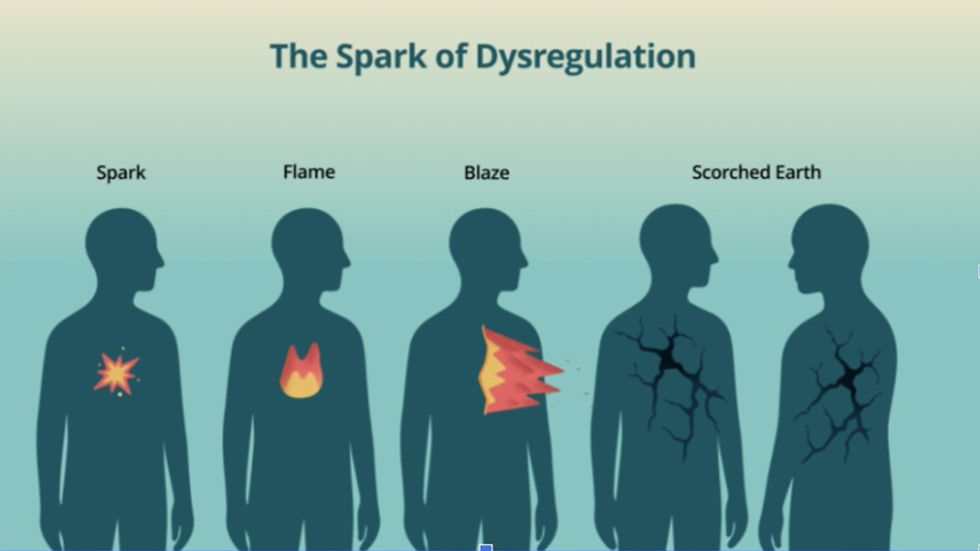
I like to think of dysregulation as a metaphor using a spark, flame, blaze, and finally scorched earth. If I can detect the spark very early on, I can shift it. I usually feel it in my breathing (shallow), my stomach (tightness), my shoulders (tense), and my jaw (clenched). That physical spark is a sacred signal to stop what I am doing and tend to myself. It’s a very important signal to honour because if we don’t, we will quickly move to a flame of negative thinking, which will lead to a blaze of negative language (fight), abandoning (flight), or a shutdown (freeze) to those around us, and the scorched earth of our closest relationships.
What are the 4 F's of Dysregulation?
You might already know the 4 F’s of dysregulation: Fight, Flight, Freeze, and Fawn. It helps to mention them here. Once you are in this blaze of dysregulation, it’s often too late. You and the most important relationships in your life are being impacted. This is why your most important relationship is the one with your nervous system. If you are tight with your nervous system, you can prevent going outside of your window of tolerance most of the time.
So how do I develop a relationship with my nervous system, you ask? You start by knowing yourself really well.
Meeting Your Needs
How are you meeting your needs for food, exercise, sleep, social interaction, creative outlets, and spiritual practices?
How do you take care of your body, mind, and spirit each day?
How do you manage your stress? How much do you take on?
How much time do you take to decompress?
What is SSA?
In the BetterLove Project, we call this SSA: Self-Awareness, Self-Reflection, and Attunement. There are many different practices you can incorporate into your life to become aware of yourself, what activates you from your past, and how you take good care of yourself now. For example:
Mindfulness
Intentional exercise
Therapy
Time in nature
Writing
The arts
Cultural connections
Take a moment and think about how you might currently practice SSA in your life.
How Can I Learn About My Nervous System?
You can learn about your nervous system by becoming better acquainted with your emotions. The most effective tool to maintain regulation is knowing how you feel and being able to express it (to yourself or another person) in a way that gets your needs met. For many of us who graduated before 2005, we didn’t learn much about emotional intelligence. In 2005, the BC school curriculum underwent significant changes to include a focus on health that included social and emotional learning. Yes, it is likely your children know more about feelings than you do.
Most of us adults have around eight words to describe our emotions. We were taught to keep our emotions small, hidden, or, best of all, not to have them. But feeling our feelings is actually how we regulate our nervous system! If we don’t feel our feelings, we become increasingly dysregulated from the residue of built-up emotion. Feeling our feelings is how we express ourselves and connect with ourselves and the people around us. It is how we move through the energy that can build up into dysregulation, and language is the most effective way to communicate our emotions.

Check out this emotion wheel. Keep one open as a tab on your browser or phone so that you can take a look when you feel a buildup of emotions. It is almost instantly regulating when we accurately name an emotion for ourselves and the people around us.
Two Simple Steps to Regulate the Nervous System
STEP 1:
Imagine yourself checking your emotion wheel as often as you want to be in a relationship with your nervous system. I recommend checking in during every transition between activities (work to home, between tasks, during your commute) at the beginning of your practice. See if you can uncover a new emotion word each week. Once you know how you are feeling, you are already starting to be in a relationship with your nervous system.
STEP 2:
The next step is to consider what the emotion might be telling you that you need to do for yourself.
For example:
I’m feeling lonely. I need to check in with a friend.
I’m feeling nervous. I need a few deep breaths.
I'm feeling frustrated. I need to step away.
Sometimes you might discover you have a little spark of dysregulation already building, and you can shift things before you walk in the door with a bunch of cortisol to share with your family, colleagues, or roommates. Instead, you will walk through the door with your emotional reality and some understanding of what you might need. You might also start to think about how to communicate that need in a way that gets your needs met. Instead of the fight response of anxiety or the avoidance of flight, you may come in with an honest appraisal of how you are doing and what you need. This honesty releases oxytocin between you and your loved ones, bringing you back into connection.
There are a few other ways to be in a relationship with our vagus nerve (see image below), and I highly encourage you to create your own go-to practices that suit you and your lifestyle best. Prevention is the greatest strategy to manage dysregulation. Consider creating daily prevention strategies in a few key categories: mindfulness/metacognition, creativity, journaling, movement, rest, being in nature, and connecting with loved ones. I used to wonder what being in a relationship with myself really meant; these are the practices that develop that connection to yourself!

About The Author
Sara Place is a Registered Clinical Counsellor with the BC Association of Clinical Counsellors. She has a full-time, online, private practice working with individuals, couples, youth, and families. Sara is also a co-founder of the BetterLove Project, a curriculum that combines attachment theory, neurobiology, and relationship science to create a comprehensive approach to relationship education and leadership.


